
This phase is a preview. Take an idea you want to sustain through a structured build, service integrations, and a public release. The complete guided curriculum is still to come.
Built by Devin / The project behind this phase
Perfect Playlist started with a Tiny Desk
After watching The Paradox's Tiny Desk concert (opens in a new tab), I asked my agent to make a playlist of the exact songs. The setlist was public. It seemed like a simple request, but the agent repeatedly got it wrong.
I got stubborn. I could have assembled the playlist myself, but I wanted to ask and receive. Perfect Playlist grew out of that insistence: take a Tiny Desk setlist, verify the songs, and turn that selection into a playlist, with Spotify as an optional destination.
I care about carrying the feeling of a performance into what I listen to next. I believe other music lovers want that too. Finding those people is part of the work ahead.
Explore Perfect Playlist (opens in a new tab)
Turn the request into a build plan
Ask your agent for a full grill-to-build conversation. Work through the user journey, inputs, outputs, integrations, and release criteria. Have it maintain a specification, decision records, project context, and ordered build tasks. Review that plan before implementation; use focused skills to carry the process between sessions.
You have already used the companion, Computer Setup, and Quick Build instructions. If you choose this phase, your agent can now explain how skills, specifications, decisions, and tickets support a longer project. Bring your saved progress and handoff; do not repeat earlier intake or erase your completed Phase 2 record.
Add only the engineering skills the project needs, including appropriate dated recommendations from Matt Pocock's resources when useful. Have the agent verify native discovery rather than calling a copied Markdown file an installation. A full 25-skill bundle is not required. Review, TDD, and orchestration can be introduced when relevant; Sandcastle or other AFK execution remains optional advanced work with a meaningful plan, bounded permissions, isolation, and cost/failure controls. Docker and Rosetta remain conditional, not graduation requirements.
Inside Perfect Playlist
Give each stage a clear job
The agent researches the public setlist and reviews the song matches. The tool receives the selected tracks, preserves their order, and handles the requested output. That became a buildable sequence: discovery, selection, playlist creation or export, and a check of the result.
Set up the integration deliberately
An API lets your project work with another service. Plan the developer account, registered application, permissions, and authentication it needs. Keep credentials outside the repository. Build and test the smallest complete connection before adding more services.
Inside Perfect Playlist
Connect Spotify through a developer app
Perfect Playlist's Spotify path uses a registered developer app and OAuth, which lets someone authorize access to their account. Setup includes a callback address for returning from sign-in. The implementation separates finding tracks from writing the approved playlist, so each part can be tested on its own.
Release something another person can install
A release includes packaging, a version, installation instructions, and a working example. Have your agent check installation outside the development environment and document the setup a new user needs.
Inside Perfect Playlist
Publish the package and its agent instructions
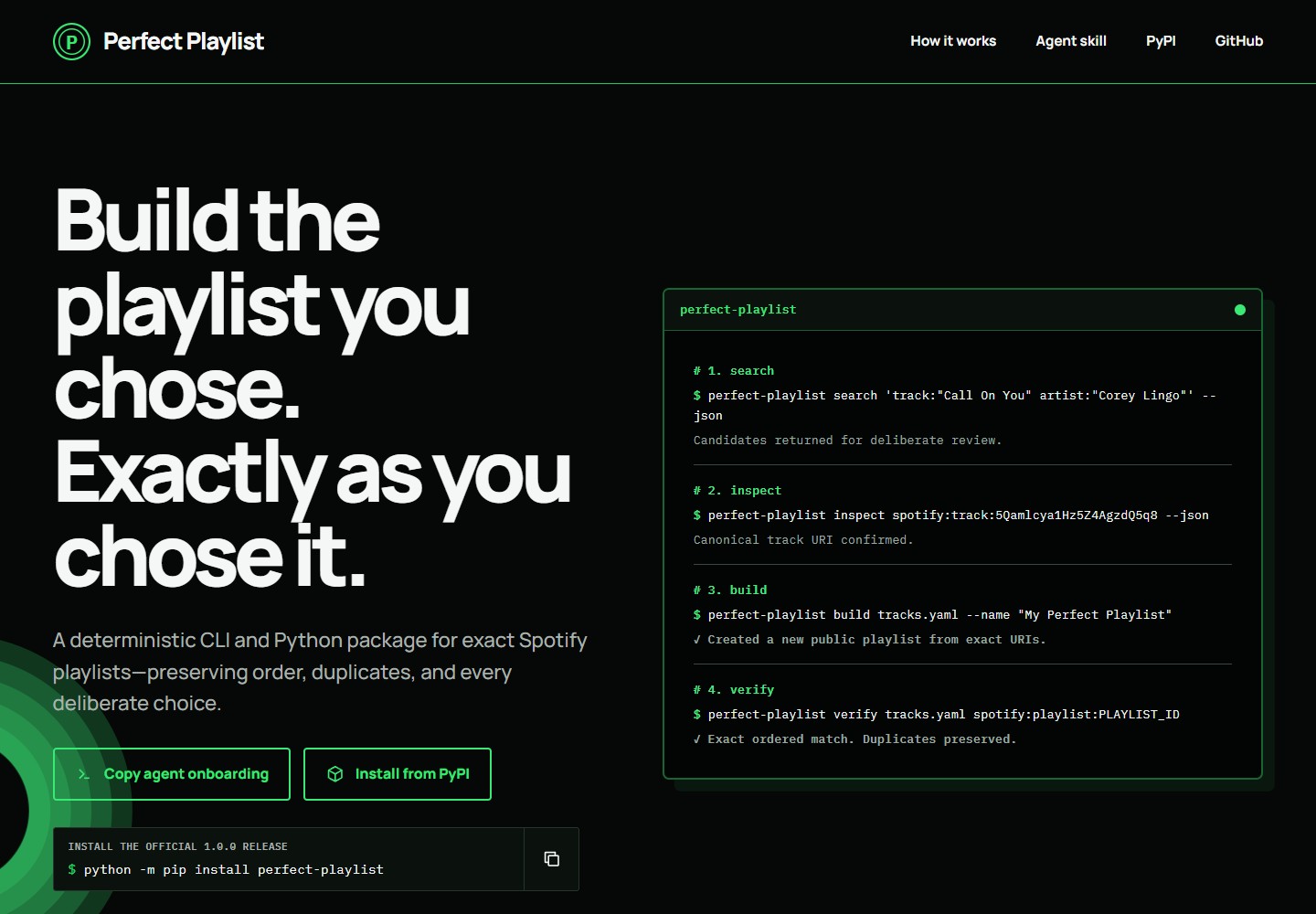
I released Perfect Playlist on PyPI (opens in a new tab), Python's package index, so people can install it on their own computers. It includes a command-line tool and an importable Python package. A hosted skill gives agents the instructions to use it.
Give the release a home
I bought perfectplaylist.dev, connected the domain to the hosted site, and added the project to my portfolio (opens in a new tab). That gives potential users a place to start and employers a concrete piece of my work to inspect.
For your release, choose a domain if it serves the project, connect its DNS records to your host, and check HTTPS. Publish a clear description, screenshots, installation or usage instructions, and a source link. Then link it from your portfolio with the problem you solved, your technical decisions, and what you shipped.
A portfolio can also be the project you grow here. My certification tracker at devthomas.site (opens in a new tab) became a home for work like Perfect Playlist. You could take a small Phase 2 portfolio further with a repeatable way to publish updates, a custom domain, and project case studies that show employers how you build.
The next step is finding listeners who share the original need. The Tiny Desk story gives me a specific way to introduce Perfect Playlist and learn who wants it.
Bring the lessons from your meaningful build into a plan for this larger release. This preview prepares that work; it does not mark a serious project complete just because it has a plan or a domain.